
Resources
Understanding Final Expenses Before Your Family Needs To
Before You Buy a Home
Buying a home is a major financial decision.
Explore the steps, costs, and financing options that can help you move forward with confidence.
Protect What You’ve Built
Your financial future deserves a strategy designed to protect your income, family, and assets. Explore five practical ways to prepare for unexpected expenses and build a stronger financial future.
Your Financial Roadmap
A simple guide to understanding where you stand, protecting your foundation, and planning for the future. Use this practical roadmap to turn your financial goals into a clear plan.
How Will You Create Retirement Income?
Explore the income sources that may support your retirement and the key questions to consider when building your plan.
Using the Library
A collection of practical guides, articles, checklists, and resources to help you make informed decisions about insurance, retirement, family finances, and your financial future.
Final habits that can strenghten your future
Simple, practical habits to help you manage your money, protect your financial foundation, and prepare for the future.
Protecting Your Business From the Unexpected
Practical guidance to help business owners understand key risks, protect their operations, and prepare for unexpected challenges.
Freedom Path Financial Family Education Roadmap
A practical guide helping families explore education goals, funding options, and financial planning for their child’s future.
Planning for Tomorrow: Long Term Care Guide
A practical guide to help families understand long term care, consider future needs, and prepare for the financial responsibilities that may come with caregiving.
Quick Financial Insights
Easy to understand visual guides covering practical financial topics, important considerations, and simple steps to help you make more informed decisions.

LEARN ABOUT MEDICARE
Understanding Your Health Coverage Options
Health insurance is one of the most important parts of a financial plan because healthcare costs can affect your monthly budget, savings, retirement income, and overall financial security. The right coverage depends on your age, health needs, household situation, income, and the type of coverage available to you.
The goal is not simply to find a plan with the lowest premium. It is to understand what the plan covers, what you may pay, and how the coverage fits into your overall financial picture.
Medicare: Understanding the Basics
Medicare is a federal health insurance program primarily for people age 65 and older, along with certain younger people with disabilities or specific medical conditions.
Medicare has several components:
Part A
Part A generally helps cover inpatient hospital care, skilled nursing facility care, hospice care, and certain home health care.
Part B
Part B generally helps cover physician services, outpatient care, preventive services, durable medical equipment, and other medically necessary services.
Part C: Medicare Advantage
Medicare Advantage plans are offered by Medicare approved private insurance companies. These plans provide Medicare Part A and Part B coverage through the private plan and may include prescription drug coverage and additional benefits.
Part D
Part D helps cover prescription drug costs. It can be obtained through a separate Medicare drug plan or as part of many Medicare Advantage plans.
Medigap
Medicare Supplement Insurance, commonly called Medigap, can help pay certain out of pocket costs associated with Original Medicare.
Medicare Is Not One Size Fits All
Two people of the same age may have very different healthcare needs.
When evaluating coverage, consider:
- Your doctors
- Your prescriptions
- Your preferred hospitals
- Your expected healthcare needs
- Your monthly premium
- Your deductibles and other out of pocket costs
- Your budget
Medicare Advantage plans can have different premiums, deductibles, copayments, provider networks, and annual out of pocket limits.
Pay Attention To Enrollment Dates
Medicare enrollment decisions are time sensitive.
For many people, the Initial Enrollment Period begins three months before the month they turn 65 and continues through three months after their birthday month. Delaying certain coverage without qualifying for an exception can result in coverage delays or penalties.
Medicare Open Enrollment generally runs from October 15 through December 7 each year. During this period, people with Medicare can make certain changes to their health and prescription drug coverage for the following year.
What About Health Insurance Before Medicare?
If you are not yet eligible for Medicare, your options may include employer coverage, individual health insurance, Marketplace coverage, or other qualifying programs.
The Health Insurance Marketplace has an annual Open Enrollment period from November 1 through January 15, although certain life events may create a Special Enrollment Period.
People who retire before age 65 and lose employer health coverage may also qualify for Marketplace coverage through a Special Enrollment Period.
Before Choosing A Health Plan
Ask yourself:
- What healthcare services do I use most?
- Which doctors and hospitals do I want to continue using?
- What prescriptions do I take?
- How much can I comfortably spend each month?
- How much could I afford if I had a major medical expense?
- Does the coverage support my overall financial plan?
The Bigger Picture
Health insurance is not simply a healthcare decision.
It is a financial planning decision.
A strong healthcare strategy can help you understand potential costs and avoid allowing unexpected medical expenses to disrupt other financial goals.
Freedom Path Financial can help you understand your insurance options and how they may fit into your broader financial strategy.
Educational information only. Medicare and health insurance rules, costs, benefits, and enrollment opportunities can change. Review official government resources and your specific plan documents before making coverage decisions.

RETIREMENT PLANNING
Building A Retirement Plan That Supports The Life You Want
Retirement planning is about more than accumulating a large account balance.
It is about answering a much bigger question:
How will you create income and maintain your lifestyle when your paycheck stops?
A successful retirement strategy considers income, expenses, investments, taxes, healthcare, longevity, Social Security, and the possibility that your needs may change over time.
Start With Your Retirement Vision
Before calculating numbers, think about the life you want to create.
- Do you want to travel?
- Spend more time with family?
- Continue working part time?
- Move to another state?
- Pay for education for children or grandchildren?
- Start a business?
- Leave assets to your family?
Your answers help define what your financial plan needs to accomplish.
Know Your Retirement Number
There is no universal retirement number.
Your target depends on factors such as:
- Your expected retirement age
- Your current savings
- Your monthly expenses
- Your expected lifestyle
- Healthcare costs
- Taxes
- Debt
- Inflation
- Life expectancy
Instead of focusing only on how much you have saved, consider how much income your assets may need to provide.
Understand Your Retirement Accounts
Employer sponsored retirement plans such as 401(k) plans allow employees to contribute part of their wages to individual retirement accounts within the plan. Employers may also contribute depending on the plan.
IRAs provide another tax advantaged way to save for retirement. Traditional and Roth IRAs have different tax treatment, so understanding the rules is important when deciding how they fit into your strategy.
Your retirement strategy may include several account types rather than relying on one source.
Do Not Forget Social Security
Social Security can be an important part of retirement income.
You can generally begin retirement benefits as early as age 62. Starting before full retirement age generally results in a lower monthly benefit, while delaying benefits after full retirement age can increase the monthly amount until age 70.
The decision should consider your health, family circumstances, other income sources, financial needs, and expected longevity.
There is no single claiming age that is right for everyone.
Healthcare Belongs In Your Retirement Plan
Healthcare expenses can become a significant part of retirement spending.
If you retire before Medicare eligibility, you need to consider how you will maintain health coverage.
Once Medicare becomes available, you still need to understand premiums, deductibles, prescription coverage, supplemental coverage, and potential out of pocket costs.
Healthcare planning should therefore begin well before retirement.
Build Multiple Income Sources
Your retirement income may come from:
- Social Security
- 401(k) or similar employer plans
- IRAs
- Investments
- Pensions
- Annuities
- Part time income
- Rental income
- Other assets
The objective is to understand how these sources can work together.
Review Your Plan Regularly
A retirement plan is not something you create once and forget.
- Your income can change.
- Your expenses can change.
- Markets can change.
- Tax rules can change.
- Your family circumstances can change.
- Your retirement date can change.
- Your plan should be reviewed as your circumstances evolve.
The Bigger Picture
Retirement planning is ultimately about creating income, flexibility, and confidence.
The goal is not simply to accumulate money.
The goal is to create a financial structure that supports the life you want to live.
Educational information only. Retirement strategies involve investment, tax, insurance, and longevity considerations. Individual circumstances vary.
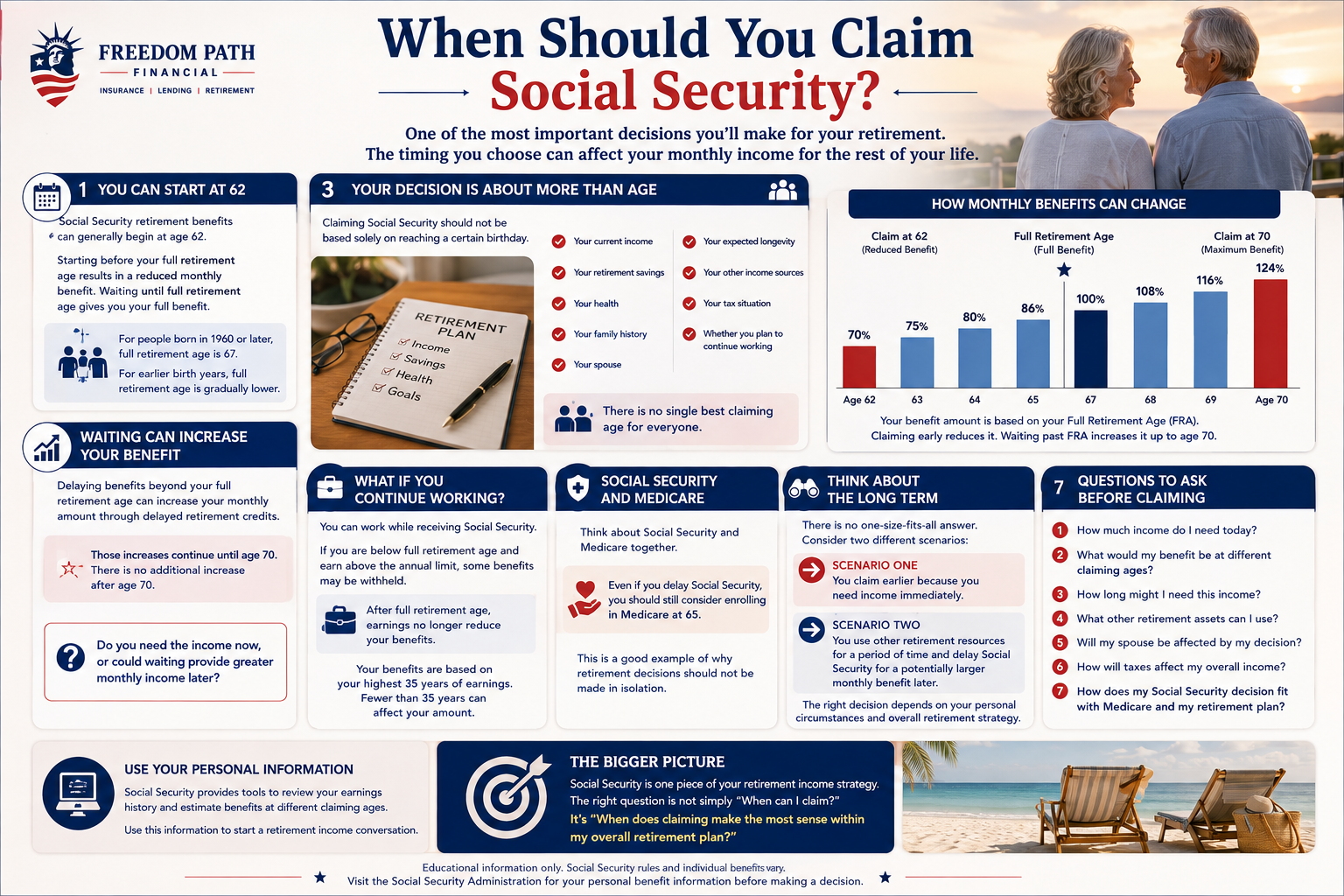
SOCIAL SECURITY PLANNING
When Should You Claim Social Security?
For many Americans, Social Security will be an important source of retirement income.
But one of the most important decisions is also one of the most misunderstood:
When should you begin receiving your benefits?
The answer can affect your monthly income for the rest of your life.
You Can Start At 62
Social Security retirement benefits can generally begin at age 62.
However, starting before your full retirement age results in a reduced monthly benefit. If you wait until full retirement age, you receive your full retirement benefit under Social Security’s rules.
For people born in 1960 or later, full retirement age is 67. For earlier birth years, full retirement age is gradually lower.
Waiting Can Increase Your Benefit
If you delay receiving retirement benefits beyond full retirement age, your benefit can increase through delayed retirement credits.
Those increases continue until age 70.
There is no additional increase for delaying retirement benefits beyond age 70.
This creates an important planning question:
Do you need the income now, or could waiting provide greater monthly income later?
Your Decision Is About More Than Age
Claiming Social Security should not be based solely on reaching a certain birthday.
Consider:
- Your current income
- Your retirement savings
- Your health
- Your family history
- Your spouse
- Your expected longevity
- Your other income sources
- Your tax situation
- Whether you plan to continue working
Social Security itself notes that there is no single best claiming age for everyone.
What If You Continue Working?
You can work while receiving Social Security.
However, if you are below full retirement age and earn more than the applicable annual earnings limit, some benefits may be withheld under the earnings test. After reaching full retirement age, earnings no longer reduce your benefits under that test.
Your work history also matters because Social Security calculates retirement benefits using your highest 35 years of earnings. If you have fewer than 35 years of earnings, years without earnings can affect the calculation.
Social Security And Medicare
Retirement planning should consider Social Security and Medicare together.
For example, people who delay Social Security still need to pay attention to Medicare enrollment. Social Security specifically notes that someone delaying retirement benefits should still consider signing up for Medicare at 65.
This is a good example of why retirement decisions should not be made in isolation.
Think About The Long Term
Imagine two different situations.
Scenario One
You claim earlier because you need income immediately.
Scenario Two
You use other retirement resources for a period of time and delay Social Security to potentially receive a larger monthly benefit later.
Neither approach is automatically better.
The right decision depends on your personal circumstances and the role Social Security plays in your overall retirement strategy.
Questions To Ask Before Claiming
- How much income do I need today?
- What would my benefit be at different claiming ages?
- How long might I need this income?
- What other retirement assets can I use?
- Will my spouse be affected by my decision?
- How will taxes affect my overall income?
- How does my Social Security decision fit with Medicare and my retirement plan?
Use Your Personal Information
Social Security provides tools that allow people to review their earnings history and estimate benefits at different claiming ages.
That information can be an important starting point for a retirement income conversation.
The Bigger Picture
Social Security is only one piece of your retirement income strategy.
The objective is to understand how Social Security interacts with your savings, investments, insurance, taxes, healthcare costs, and lifestyle goals.
The right question is not simply, “When can I claim?”
It is:
“When does claiming make the most sense within my overall retirement plan?”
Educational information only. Social Security rules and individual benefits vary. Visit the Social Security Administration for your personal benefit information before making a claiming decision.
Even if you do not own your home, your personal belongings deserve protection. Renters insurance helps cover your possessions, provides liability protection, and can assist with temporary living expenses if your rental becomes uninhabitable.

FINANCIAL PROTECTION
Protecting The People And Goals That Depend On You
Life insurance is often discussed as a product.
A better place to begin is with a question:
What financial responsibilities would continue if your income disappeared tomorrow?
For many families, the answer could include a mortgage, rent, car payments, childcare, education, debt, household expenses, and long term financial goals.
Life insurance can provide a death benefit to named beneficiaries when the insured person dies.
Who Might Need Life Insurance?
Life insurance needs vary based on age, income, family responsibilities, financial obligations, and long term goals.
You may want to consider coverage if:
- Someone depends on your income
- You have a mortgage
- You have children
- You have significant debts
- You provide financial support to another family member
- You own a business
- You want to provide funds for final expenses
- You want to leave money to beneficiaries
The need for coverage can also change throughout your life.
Term Life Insurance
Term life insurance provides coverage for a specified period.
It may be appropriate when protection is needed for a specific financial responsibility or period of life.
For example, someone may want coverage while children are dependent or while a mortgage remains outstanding.
Term insurance generally costs less than permanent insurance during the early policy years, although premiums and renewal terms vary by policy.
Permanent Life Insurance
Permanent life insurance is designed to provide coverage for the insured’s lifetime when policy requirements are met.
Some permanent policies include cash value features.
Types can include:
- Whole life
- Universal life
- Variable life
These policies can be more complex than term insurance, so understanding guarantees, costs, cash values, policy assumptions, and potential changes is important.
How Much Coverage Might You Need?
There is no universal amount.
A useful starting point is to consider the financial impact your death could have on the people who depend on you.
Think about:
- Income replacement
- Mortgage or housing costs
- Other debts
- Final expenses
- Childcare
- Education
- Emergency savings
- Spouse’s retirement needs
- Business obligations
- Future financial goals
The NAIC recommends considering income, financial obligations, dependents, final expenses, education, debt, and long term family needs when evaluating coverage.
Do Not Forget Your Beneficiaries
Choosing the right coverage is only part of the process.
Beneficiary information should also be reviewed.
Life insurance benefits are generally paid to the named beneficiaries, so keeping beneficiary designations current is important. The NAIC also recommends making sure beneficiaries know who the insurer is, the benefit amount, and where the policy information is stored.
Major life changes can be a good reason to review your beneficiaries.
These may include:
- Marriage
- Divorce
- Birth or adoption
- Death of a beneficiary
- Major changes in financial responsibilities
Review Before Replacing A Policy
If you already have life insurance, do not automatically cancel an existing policy because you are considering a new one.
A new policy may have different premiums, underwriting requirements, benefits, exclusions, guarantees, and cash value characteristics.
The NAIC recommends carefully comparing an existing policy with any replacement before making a change.
Life Insurance Is Part Of A Bigger Plan
Life insurance should not be viewed separately from the rest of your financial strategy.
It can work alongside:
- Emergency savings
- Retirement planning
- Estate planning
- Debt management
- Education planning
- Asset protection
- Final expense planning
The purpose is to create financial protection that supports the people and goals that matter most.
Questions To Ask
- Who depends on my income?
- How long would they need financial support?
- What debts would remain?
- What goals would I want to protect?
- How much coverage can I comfortably afford?
- Do I understand the policy guarantees and costs?
- Are my beneficiaries current?
- When should I review my coverage again?
The Bigger Picture
Life insurance is not simply about preparing for death.
It is about protecting the financial life you are building today and the people who may depend on it tomorrow.
The right amount and type of coverage depends on your individual circumstances.
Educational information only. Life insurance products vary significantly. Policy costs, guarantees, benefits, cash values, and eligibility depend on the specific policy and the applicant. Review policy documents carefully and consult appropriately licensed professionals before making a decision.
Financial Guidance in Real Life
Practical insights to help you protect today and plan confidently for tomorrow.
Explore our video resources for straightforward guidance on life insurance, final expenses, health coverage, and retirement planning. From understanding why getting covered early can save you money to preparing for the financial changes that come with retirement, these videos offer practical insights to help you make informed decisions for yourself and your family.
Contact Us
Send Your Message
Whether you are planning for your family's future, exploring insurance options, preparing for retirement, navigating Medicare, or financing a home, Freedom Path Financial is here to guide you every step of the way. We take the time to understand your goals, answer your questions, and provide personalized solutions that help you build financial confidence and lasting security.
Location
Tampa Bay & Statewide
Phone Number (Eng)
+1 (813) 665-0034